
Robotic Assembly Line
A Robotic Assembly Line is no longer optional. It has become the core of fast-paced and high-precision manufacturing environments. Industries adopting industry automation solutions are witnessing exponential improvements in efficiency as well as product standardization with producer capacity. Manufacturers are able to increase output while maintaining a consistent quality standard across every batch with robots integrated into material handling and part fitting, as well as fastening, inspection, and packaging. Robotics has become the universal language of modern assembly, from automotive and electronics to heavy engineering and consumer goods.
Automotive manufacturing and assembly once relied heavily on manual efforts. It slowed the throughput and increased the variability between units. As one of the dedicated robot manufacturing companies, we help the process of shifting entities. Automated arms now handle:
- Welding
- Body framing
- Powertrain mounting
- Finishing
They do so with unmatched consistency. Each automobile passes through a synchronized robotic workflow where human error is almost eliminated. The transformation has allowed expanding the industrial applications of robots and enabled the automotive industries to reduce lead time and improve component accuracy, in addition to supporting increased production demand. All of this is while maintaining global safety and quality benchmarks through advanced industry automation solutions.
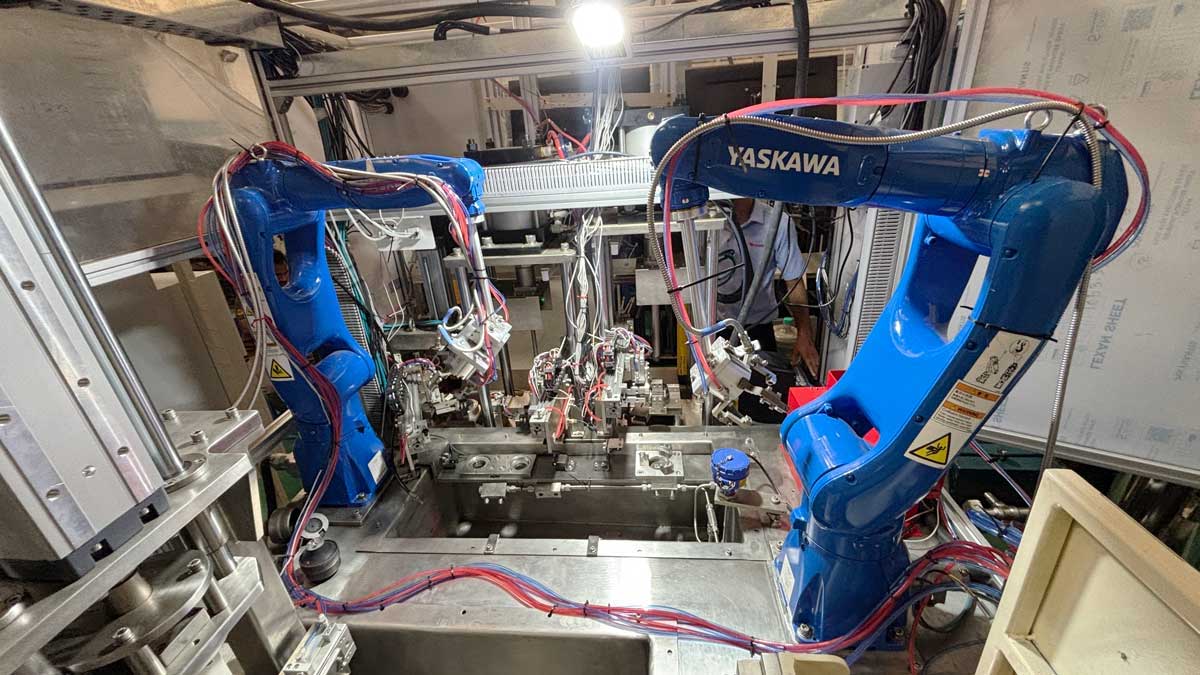
A Robotic Assembly Line performs tasks at speeds beyond human capacity and maintains consistent accuracy throughout long production shifts. There are no breakdowns or exhaustion, or variations in output quality. It means manufacturers can experience -
- Lower production errors
- Faster assembly cycle time
- Reduced labor dependency
- Predictable output volumes
- Higher return on investment
Technowings builds Robotic Assembly Line solutions engineered around real manufacturing challenges in India. Every robotics line is tailored to part complexity and production speed, along with load requirement and footprint, as well as automation depth. Our experience in system integration and industry automation solutions enables our products to help industries in India to scale faster and reduce manual workload, which helps maintain world-class consistency.
What Is Automotive Manufacturing and Assembly?
In order to guarantee accuracy, strength, safety, and consistent performance, automotive production and assembly entail creating vehicle components and combining them into a whole unit using defined procedures.
How Do Robots Improve Efficiency in Automotive Manufacturing?
Through quicker cycle times, accurate handling, less downtime, reliable welds and fittings, and increased operational capability beyond human fatigue or repetitive strain restrictions, robots improve automotive efficiency.
Benefits of Using Robots in Automotive Production
Higher output, consistent quality, fewer reworks, safer working conditions, increased cost- efficiency, scalable production capacity, and superior repeatability across large-volume manufacturing processes are all made possible by robotic assembly.
What Are the Different Types of Industrial Robots Used in Manufacturing?
SCARA, articulated, delta, collaborative, and Cartesian robots are frequently used in manufacturing; each is appropriate for specific activities such as welding, pick-and-place, inspection, fastening, and material transfer.
How Do Industrial Robots Contribute to Sustainable Manufacturing Practices?
Robots offer cleaner, eco-focused production that is in line with contemporary sustainability standards. They also reduce waste, minimize energy consumption, remove faults, optimize material usage, and assist recycling operations.